

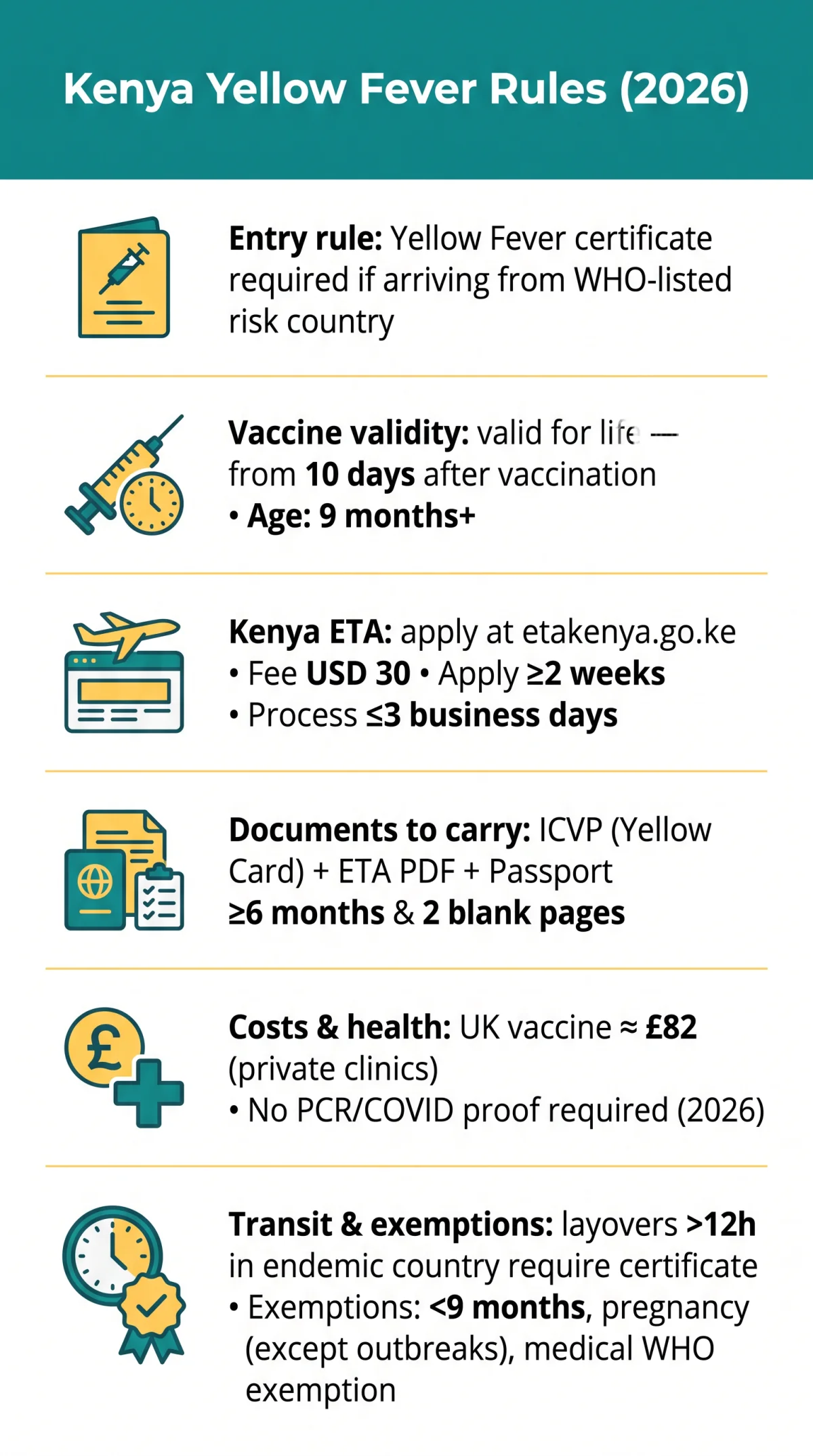
UK travellers must hold a valid yellow fever vaccination certificate when entering Kenya from a WHO-listed risk country. The certificate is checked at JKIA port health and should be carried alongside the Kenya ETA approval (which replaced the eVisa in January 2024). The vaccine is valid for life. No PCR test or COVID-19 vaccination proof is required as of 2026.
Reviewed by a UK travel health specialist. Last updated: 9 September 2026. Next review: 9 March 2027. Requirements can change without notice; always check gov.uk Kenya travel advice and health.go.ke before booking.
This is an independent information guide, not the Kenya ETA service. We do not process applications and do not charge government fees. The only application channel is etakenya.go.ke.
Yellow Fever Vaccination Requirements for Kenya
A yellow fever vaccination certificate is mandatory for UK travellers arriving from WHO-listed transmission-risk countries, valid for life from 10 days post-injection with no booster required.
Kenya eVisa yellow fever rules make a vaccination certificate mandatory for UK travellers arriving from WHO-listed risk countries in sub-Saharan Africa and tropical South America. The certificate is valid for life from 10 days post-injection. Missing a valid certificate results in denied boarding or entry.
Who Needs a Yellow Fever Certificate?
Kenya eVisa yellow fever requirements apply to all travellers aged 9 months and over arriving from risk countries. Direct UK departures without layovers in endemic zones are generally exempt. Decision: arriving from a risk country? Certificate required. Not from a risk country? Generally exempt but recommended.
Yellow Fever Certificate and ETA Application
The International Certificate of Vaccination and Prophylaxis (ICVP) is not uploaded during the ETA application at etakenya.go.ke. No upload field exists for vaccination proof. The certificate is verified physically at the JKIA port health desk. Carry your printed or digital ICVP alongside the ETA approval letter.
Yellow Fever Exemptions
Exempt categories: infants under 9 months, pregnant women (except during outbreaks), severe egg protein allergy, severe immunodeficiency, and thymus disorder. Exemption requires a WHO International Certificate of Exemption stamped by a registered UK clinician. Obtain from your GP or a registered travel clinic on the official WHO form.
Yellow Fever Transit Rules
Airside transit under 12 hours through an endemic country does not require a certificate per WHO International Health Regulations (2005); layovers exceeding 12 hours (e.g., Addis Ababa, Entebbe) do require one.
Kenya ETA Application, Documents, and COVID-19 Rules (2026)
The Kenya ETA replaced the eVisa in January 2024, costs USD 30, and must be applied for at etakenya.go.ke at least 2 weeks before departure, with no COVID-19 test or vaccination proof required.
How to Apply for the Kenya ETA
Kenya eVisa yellow fever requirements now operate through the ETA system. Apply solely at etakenya.go.ke. Third-party sites cause automatic denial, and no visa on arrival exists. The fee is USD 30 plus processing fees; processing takes within 3 business days, so apply at least 2 weeks before departure.
Required documents: a scanned passport bio page and a passport-size photo. Your passport must hold 6 months validity from arrival and 2 blank pages. Approval arrives as a PDF via email. Children and infants need their own ETA. Existing unexpired eVisas remain valid until expiry.
COVID-19 and PCR Test Requirements (2026)
Kenya eVisa yellow fever rules do not extend to COVID-19 proof: no pre-departure test or vaccination proof is required (health.go.ke, 2026). Symptomatic travellers must complete the Jitenge passenger locator form and take a COVID-19 antigen test at their own cost. A positive result triggers a PCR test, also at own cost. Severe cases face isolation per prevailing requirements.
UK Health Preparations: Vaccinations, Clinics, and Malaria Prevention
Yellow fever vaccine costs £82 at private UK clinics; malaria prophylaxis requires a GP prescription 4 to 6 weeks before travel.
Kenya eVisa yellow fever compliance starts with a £82 single-dose vaccine at private UK clinics. Superdrug Health Clinics (booking: 0333 311 1007), Nomad, Boots, and MASTA offer private services; the NHS rarely provides yellow fever. Book at least 8 weeks before departure per FCDO guidance. Multi-dose vaccines require 4 to 6 weeks lead time. For detailed UK clinic guidance, see the TravelHealthPro Kenya guide.
| Vaccine | Cost (£) | Doses |
|---|---|---|
| Yellow fever | £82 | 1 |
| Hepatitis A | £67 | 1 |
| Typhoid | £42 | 1 |
| Tetanus booster | £38 | 1 |
| Poliomyelitis | £32 | 1 |
| Cholera | £72 | 2 |
| Hepatitis B | £156 | 3 |
| Meningococcal meningitis | £50 | 1 |
| Rabies | £246 | 3 |
Malaria Prevention for Kenya
Risk applies to all areas below 2,500 m (8,200 ft), including Masai Mara, Tsavo, and coastal regions. Central Nairobi needs no chemoprophylaxis. The primary parasite is P. falciparum with documented chloroquine resistance. GP-prescribed options: doxycycline, Malarone (atovaquone/proguanil), mefloquine. Non-medicinal measures: DEET-based repellent, long sleeves at dusk and dawn.
Travel Insurance and Medical Cover for Kenya
Travel insurance with medical evacuation coverage of $100,000+ for air ambulance is strongly recommended for Kenya, though not a statutory entry requirement.
Kenya eVisa yellow fever requirements do not mandate travel insurance, but it is strongly recommended for all UK visitors (per gov.uk guidance). Look for $100,000+ medical evacuation, safari coverage, Cancel for Any Reason (CFAR), pandemic protection, and electronics cover. Typical cost runs USD 80 to 200 per person for a 10 to 14 day safari. Aggregators such as World Nomads and InsureMyTrip allow side-by-side comparison.
AMREF Flying Doctors provides air ambulance evacuation across Kenya and East Africa. Kenya eVisa yellow fever travellers should verify whether their policy includes an AMREF partnership. The Kenya emergency number is 999. FCDO advises against all travel to parts of Kenya and against all but essential travel to other parts. Check current FCDO Kenya travel advice before booking.
Arrival Process at JKIA: What to Expect
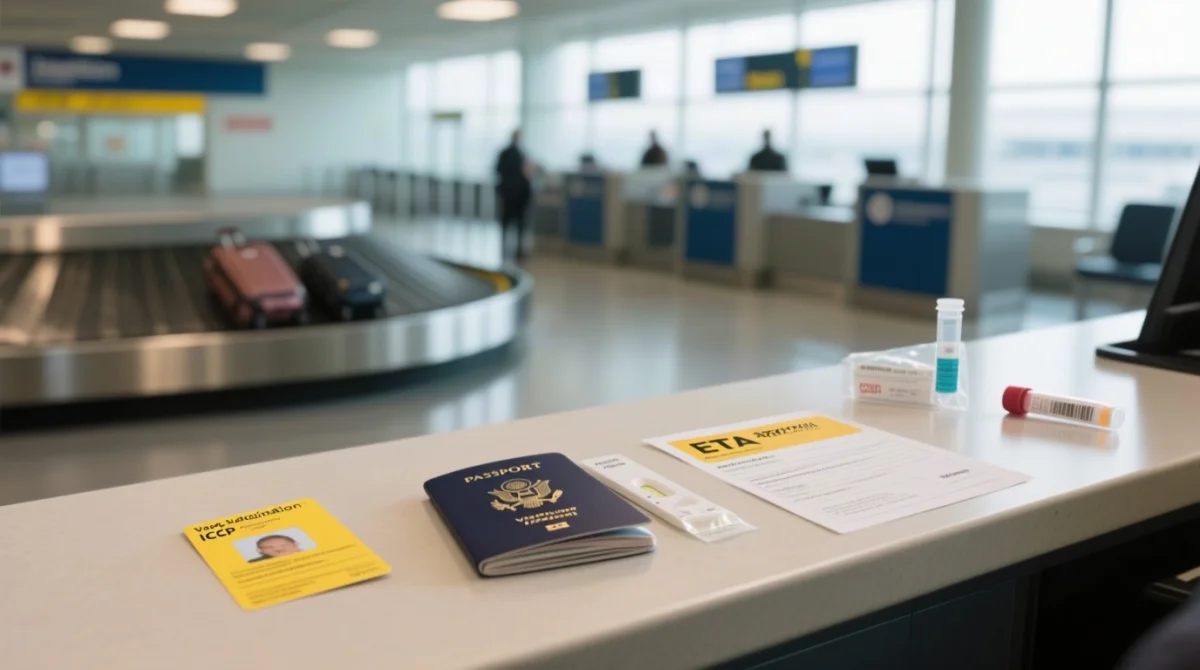
JKIA arrival proceeds through health screening (Yellow Card and ETA check), immigration, baggage claim, and customs, with the yellow fever certificate verified at the port health desk before immigration.
Health screening
Port health desk inspects your Yellow Card and ETA approval before immigration.
Immigration
ETA verification, passport check (6+ months validity, 2+ blank pages), return ticket.
Baggage collection
Proceed to the designated carousel.
Customs
Declare goods subject to tax or duty.
Kenya eVisa yellow fever certificate checks happen at Step 1. Kenya eVisa yellow fever travellers should have passport, ETA approval PDF, Yellow Card, and return ticket ready for inspection. Symptomatic arrivals must complete the Jitenge form and take an antigen test at own cost.
Frequently Asked Questions
Do I need a yellow fever vaccine to get a Kenya entry authorisation as a UK traveller?
Yes, if arriving from a WHO-listed risk country. Certificate checked at JKIA, not during ETA application. Applies to travellers aged 9 months and over. Not from a risk country? Recommended but not required.
How do I upload my yellow fever certificate during the Kenya ETA application?
You do not upload it. The ETA form at etakenya.go.ke has no vaccination upload field. Carry your printed or digital ICVP to JKIA for physical inspection at the port health desk.
Do I need a PCR test to enter Kenya from the UK in 2026?
No. No pre-departure PCR test or COVID-19 vaccination proof is required. Only symptomatic arrivals take an antigen test at JKIA at their own cost.
Who is exempt from yellow fever vaccination for Kenya travel?
Infants under 9 months, pregnant women (except during outbreaks), and people with severe egg allergy, immunodeficiency, or thymus disorder. Exemption requires a WHO-form stamped by a registered UK clinician.
Is my old Yellow Card (pre-2016) still valid for Kenya entry?
Yes. Yellow fever certificates are valid for life from 10 days post-vaccination. No booster or reissue is needed regardless of the date printed on the card.
How long does the Kenya ETA take to process?
Typically within 3 business days. Apply at least 2 weeks before departure at etakenya.go.ke. Fee: USD 30 plus processing fees.
What happens if I show flu-like symptoms at JKIA on arrival?
You must complete the Jitenge passenger locator form and take an on-arrival antigen test at your own cost. If positive, a PCR test follows at your own cost.
What travel insurance do I need for a Kenya safari?
Not legally required but strongly recommended. Look for $100,000+ medical evacuation cover, safari activity inclusion, and AMREF Flying Doctors partnership. Typical cost: USD 80 to 200 per person.
Which countries are classified as yellow fever risk by the WHO?
Most of sub-Saharan Africa and parts of tropical South America. No Asian countries are currently on the WHO transmission-risk list. Transit over 12 hours through a risk country also triggers the requirement.
Can I carry prescription pain medication (e.g., codeine) to Kenya?
Kenya has strict regulations on controlled medications. Carry original packaging, a GP letter, and a prescription copy. Check with the Kenyan High Commission for permitted quantities.