
Last reviewed: September 2026 – based on Kenya Directorate of Immigration Services official guidelines.
The Kenya eTA is required for all short-term UK visitors and covers both tourist and basic business trips such as meetings. A separate business visa or work permit is only necessary if you plan to engage in paid employment, long-term contracts, or establish a business in Kenya. Apply through the correct portal depending on your permit type.
The eTA replaced the eVisa system in January 2024 and permits stays up to 90 days. It is applied for exclusively online at etakenya.go.ke. Activities like networking, conferences, and site visits are permitted on a Business eTA, while any form of paid or unpaid local employment requires a specific work permit processed through a separate system.
What Is the Kenya eTA and Who Needs It?
The Kenya eTA is a mandatory pre-travel authorisation for all short-term visitors, including UK passport holders, covering both tourism and basic business visits of up to 90 days. The Kenya eTA is applied for exclusively online at etakenya.go.ke. It is not issued on arrival, so UK travellers must submit their application at least 72 hours before departure.
The Kenya eTA requires a passport valid for 6 months on entry. All children below 18 must hold an individual eTA. The standard single-entry fee is $51.
Exempt categories include:
- Citizens of East African Partner States (Burundi, DRC, Rwanda, South Sudan, Tanzania, Uganda) – stays not exceeding 180 days
- Diplomatic and official passport holders (required to apply but exempt from paying the fee)
- UN Laissez-Passer holders (required to apply but exempt from paying the fee)
- Serving members of the British Military
- Holders of valid Kenya Permanent Residence, Work Permits, Passes, or Re-entry Passes
Kenya eTA vs Business Visa – Key Differences
The Kenya eTA covers short business visits for up to 90 days at $51, while a Multiple Journeys Visa suits frequent UK travellers with 3 to 12 months validity at $101. Engaging in any form of business or employment without a requisite permit or pass is a statutory offence under Kenya Visa Regulations.
| Criteria | Tourist eTA | Business eTA | Multiple Journeys Visa |
|---|---|---|---|
| Purpose | Tourism | Meetings, conferences, negotiations, signing contracts, site visits | Frequent business travel |
| Max stay | 90 days | 90 days | 3 to 12 months |
| Entry type | Single entry | Single entry | Multiple entry |
| Fee | $51 | $51 | $101 |
| Processing time | ~72 hours | ~72 hours | 4+ weeks |
| Employment permitted | No | No (paid or unpaid) | No (business activities only) |
| Key supporting documents | Hotel booking, return ticket | Employer letter, host invitation, signatory staff ID | Sponsoring organisation letter, host passport copy, passport valid minimum 1 year |
Tourist eTA vs Business eTA
Both eTA variants share the same fee, 90-day stay limit, and processing time through the same portal. A Business eTA requires: invitation letter and employer letter. A tourist application needs only hotel confirmation and return flight proof. For a full breakdown of what each option costs, see our Kenya eTA fees guide for UK travellers.
When Does a Business eTA Stop Being Enough?
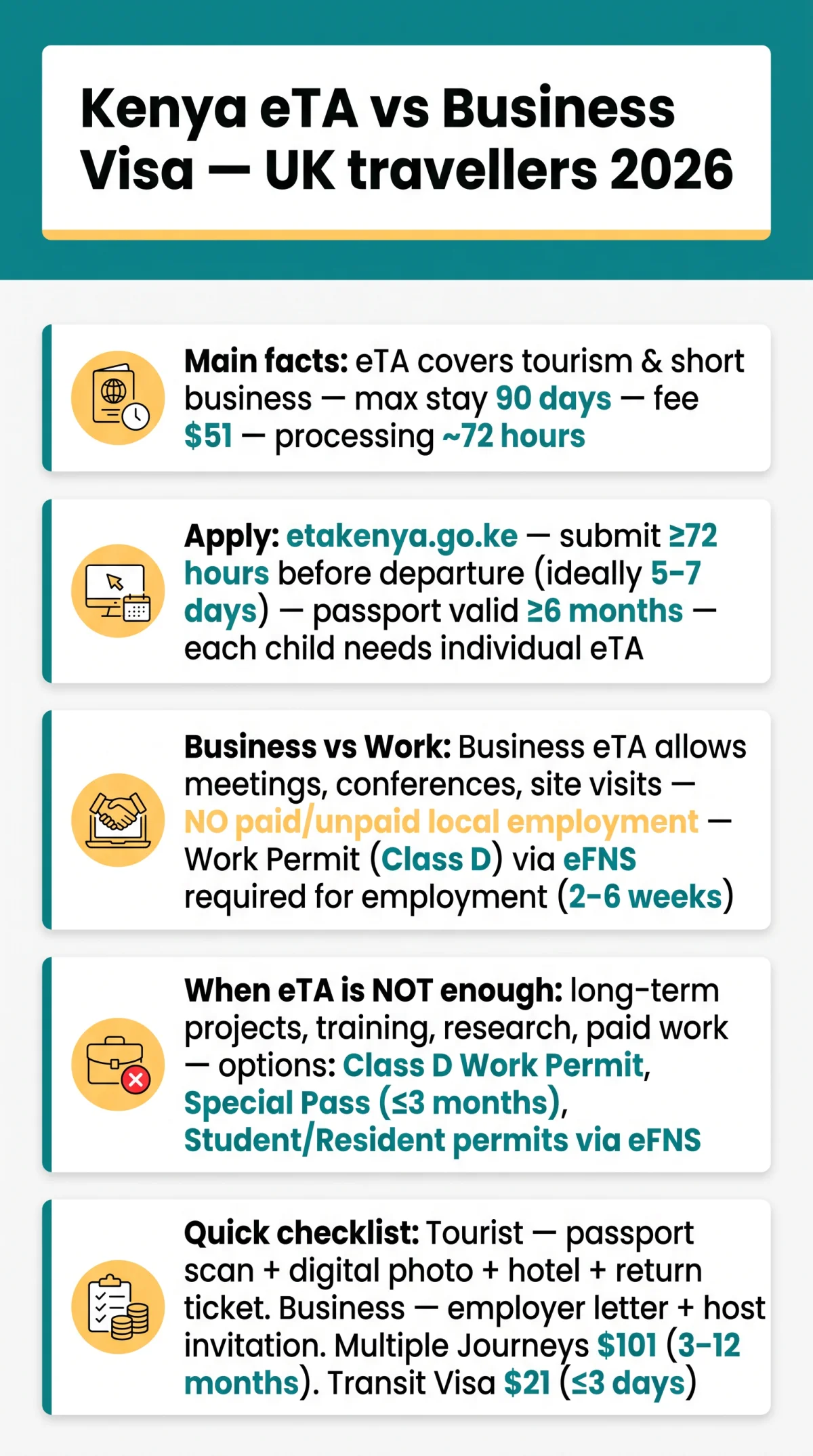
A Kenya Business eTA prohibits any paid or unpaid employment. Performing local work, including long-term project supervision or training staff, is a statutory offence requiring a Class D Work Permit. According to the Kenya Citizenship and Immigration Act and eTA regulations published in January 2024, engaging in business or employment without a requisite permit or pass is an offence.
Permitted on Business eTA: short meetings, conferences, negotiations, site inspections, signing contracts, attending trade fairs, networking events.
Prohibited on Business eTA: paid or unpaid local employment, self-employment, long-term project supervision, training local staff, charity or voluntary work, research, internship.
Example: A UK project manager spending 6 weeks supervising construction in Nairobi exceeds eTA allowances. This requires a Class D Work Permit or, for shorter assignments up to 3 months, a Special Pass.
Work Permits, Student Passes, and Resident Permits
UK nationals engaging in employment, academic study, or long-term residence must obtain a Class D Work Permit, Class M Student Pass, or Resident Permit via the eFNS portal, a system entirely separate from the Kenya eTA platform. The Kenya eTA does not grant rights to work, study, or reside in Kenya beyond short visits.

Work Permit (Class D)
- Requires employer sponsorship and approval by the Director of Immigration Services, Nairobi
- Applied through the eFNS portal; processing takes 2-6 weeks
- Authorises all paid and unpaid employment, including voluntary work
Student Pass (Class M)
- Sponsorship by an accredited Kenyan educational institution required
- Documents: acceptance letter, proof of funds, medical certificate
- Applied through the eFNS portal
Resident Permit (Class A/B)
- Class A covers diplomats and dependants; Class B covers employment-based residents
- Class G (investor) and Class K (retiree with proof of offshore pension) also available
- All applications processed via the eFNS portal
Side-by-Side Comparison – eTA vs Work Permit vs Student Pass vs Resident Permit
For UK travellers undecided between a short Kenya eTA trip and a longer commitment, this comparison clarifies purpose, maximum stay, fees, and processing times across all five Kenya entry categories.
| Entry Document | Purpose | Max Stay | Fee | Processing | Portal |
|---|---|---|---|---|---|
| Tourist eTA | Tourism | 90 days | $51 | ~72 hours | etakenya.go.ke |
| Business eTA | Short business | 90 days | $51 | ~72 hours | etakenya.go.ke |
| Multiple Journeys Visa | Frequent business | 3-12 months | $101 | 4+ weeks | Director of Immigration |
| Work Permit (Class D) | Employment | Per permit | Set by Director | 2-6 weeks | eFNS portal |
| Student Pass (Class M) | Study | Per enrolment | Set by Director | 2-6 weeks | eFNS portal |
| Resident Permit (Class A/B) | Long-term residence | Per permit | Set by Director | 4-8 weeks | eFNS portal |
Key takeaways: the Kenya eTA covers 90% of short visits; work, study, and residence require the eFNS portal; fees and timelines escalate with complexity; overstay fines apply.
How to Apply for Each Kenya Permit
The Kenya eTA is processed entirely online at etakenya.go.ke, while all long-term permits must be lodged through the separate eFNS portal (Electronic Foreign Nationals Services). For a detailed walkthrough of the eTA submission process, see our step-by-step Kenya eTA application guide.
eTA portal – short-term applications
Visit etakenya.go.ke, select your purpose (Tourism or Business), complete the form, upload your passport scan, digital photo, employer letter, and host invitation. Pay the $51 fee. eTA issued via email within at least 72 hours – submit 5-7 days before departure.
eFNS portal – long-term permits
Register a separate eFNS account for Class D Work Permits, Class M Student Passes, and Class A/B Resident Permits. The eFNS portal is entirely separate from the eTA platform.
For UK-specific queries, the Kenya High Commission is located at 45 Portland Place, Marylebone, London W1B 1AS, open Monday-Friday 09:00-13:00 and 14:00-17:00.
eTA customer support is available by phone at +254 717 436 070 and WhatsApp at +254 110 922 064. Use the “Validate eTA” service on etakenya.go.ke to check your Kenya eTA application status before travel. Official fees remain fixed at $51; applicants are strongly advised to use the government portal at etakenya.go.ke to avoid unnecessary charges.
Common Questions for UK Travellers Heading to Kenya
Can I switch from a Kenya eTA to a work permit while in Kenya? Generally, you cannot convert an eTA to a work permit or student pass from within Kenya. Departure and re-entry on the correct permit is the standard procedure.
What happens if I overstay my Kenya eTA? Overstaying the permitted 90-day threshold without a formal extension risks daily fines, detention, deportation, and future application refusal. Apply for an extension through the Department of Immigration Services while your current eTA is still valid, providing evidence of sufficient funds. For more on stay limits and penalties, see our guide on Kenya eTA validity and 90-day stay rules.
Is the East Africa Tourist Visa an option? Yes. The East Africa Tourist Visa costs $101, offers 90-day multiple-entry validity, and covers Kenya, Rwanda, and Uganda. It is ideal for regional tourism itineraries.
What about regional re-entry? The Kenya eTA allows re-entry within validity from Uganda, Tanzania, Rwanda, and Burundi without requiring a new eTA, provided travel is restricted to EAC countries only.
What is a Special Pass? For contractual or technical assignments up to 3 months that exceed eTA allowances but do not require a full Class D Work Permit, a Special Pass is available through the eFNS portal.
Can I do research on an eTA? No. A standard eTA prohibits research and unpaid volunteer work. A NACOSTI (National Commission for Science, Technology and Innovation) permit is required.
Is there a Transit Visa? Yes. A Transit Visa costs $21 and permits stays not exceeding 3 days, applied for through the same portal as the Kenya eTA. For more details, read our complete guide to the Kenya transit visa.
FAQ
Do UK citizens need a visa for Kenya in 2026?
Yes, UK citizens need an approved Kenya eTA before travel. You must apply online at etakenya.go.ke at least 72 hours before your departure. The eTA replaced the eVisa system in January 2024 and is mandatory for all short-term visitors, including children below 18 years of age.
What is the difference between a Kenya eTA and a business visa?
A Business eTA permits short business visits like meetings and conferences for up to 90 days at a cost of $51. A Multiple Journeys Visa allows multiple entries over 3 to 12 months at $101 and is suited for frequent travellers returning within a year. Both prohibit paid employment.
Can I attend business meetings in Kenya on a tourist eTA?
Yes, you can attend meetings, but it is recommended to select the business purpose when applying for your eTA to ensure your supporting documents match your intended activities. A Business eTA requires an invitation letter from a Kenyan host and an employer letter from your UK company.
How much does a Kenya business visa cost for UK applicants?
The Business eTA costs $51 for a single entry. A Multiple Journeys Visa for frequent business travel costs $101. All visa fees are non-refundable. Applicants are advised to use the government portal at etakenya.go.ke to avoid unnecessary charges.
How long does it take to get a Kenya work permit?
Processing for a Class D Work Permit through the eFNS portal typically takes 2 to 6 weeks. The permit must be approved by the Director of Immigration Services in Nairobi. It is required for all paid or unpaid employment in Kenya, including voluntary work.
Can I change my Kenya eTA to a work permit while in the country?
Generally, you cannot convert an eTA to a work permit from within Kenya. Departure and re-entry on the correct permit is the standard procedure. Work permits, student passes, and resident permits are processed through the separate eFNS portal.
What happens if I overstay my Kenya eTA?
Overstaying the permitted 90-day threshold without a formal extension risks daily fines, detention, deportation, and future application refusal. You must apply for an extension through the Department of Immigration Services while your current eTA is still valid.
Is there a separate student visa for Kenya, or can I study on an eTA?
A standard eTA does not permit study. You need a Student Pass (Class M), applied for through the eFNS portal.
Where do I apply for a Kenya work permit – the eTA portal or a different system?
Work permits, student passes, and resident permits are applied for through the separate eFNS portal.
This article is for informational purposes only and is not an official government source. Always verify requirements at etakenya.go.ke or with the Kenya High Commission in London. Legal basis: Kenya Citizenship and Immigration Act and eTA regulations published in January 2024. Our editorial team has guided UK business travellers through the Kenya eTA process since 2024 and recommends submitting your employment letter and host invitation at least 7 days before departure to avoid last-minute errors.